Site Survey
Site Survey
From Capture to Production: How Structured Scan Data Supports the Entire Workflow
Structured scan data can extend beyond measurement to support design, drafting, coordination, and production. This article explores how preserving spatial continuity — rather than selected dimensions alone — improves alignment and reduces downstream friction across the entire workflow.
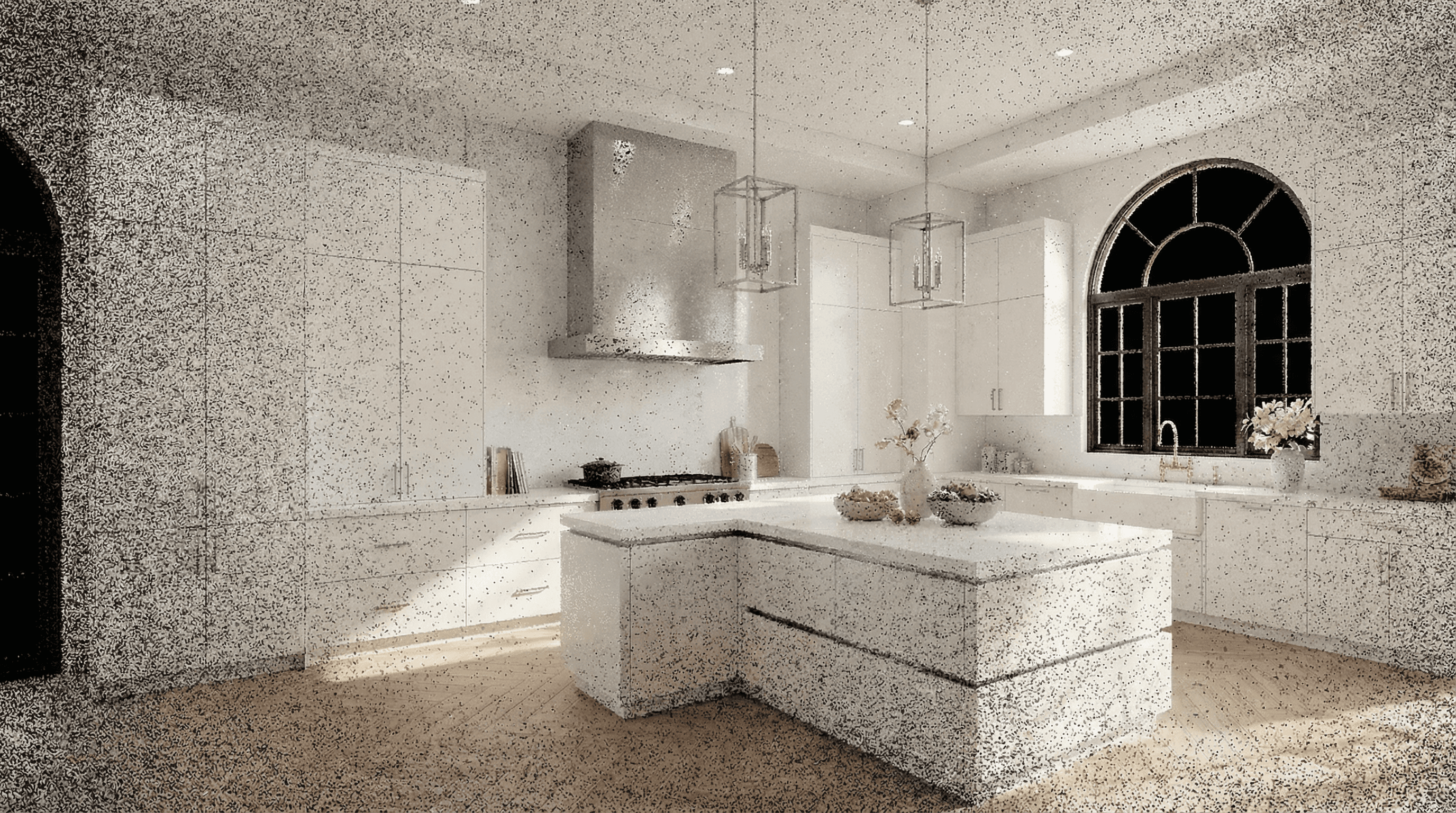
From Capture to Production
In most projects, measurement is treated as an isolated phase.
The site is surveyed.
Dimensions are recorded.
Drawings are drafted.
Production begins.
Each stage operates with a degree of separation.
When measurement data enters the design phase, it is already compressed — translated into selected dimensions and reconstructed geometry. From there, every downstream decision depends on how accurately that reconstruction reflects reality.
The transition from scan data to structured geometry changes the continuity of this chain.
Design: Working From Spatial Context, Not Assumption
When designers begin with structured scan data — not just notes or traced references — they work with resolved planes and preserved relationships.
Instead of asking:
Is this wall perfectly vertical?
Is that corner truly square?
Should this span be rechecked?
They see the underlying geometry directly.
Subtle deviations remain embedded in the model. Angular differences are not idealized away. Surfaces are represented as they exist.
This reduces early-stage reinterpretation.
The design phase becomes less about reconstructing the space and more about making spatial decisions within a verified framework.
Drafting: From Rebuilding to Extracting
Traditional drafting rebuilds geometry from fragments.
Structured scan data shifts drafting toward extraction.
Wall planes are already defined.
Openings are identified in context.
Intersections are resolved algorithmically.
Instead of manually tracing edges over point clouds, the drafter refines a generated structure.
The workload shifts:
Less reconstruction.
More validation and refinement.
The distinction matters in complex layouts where minor angular inconsistencies can cascade through cabinetry or panel systems.
Coordination: A Shared Spatial Reference
Design, contracting, and production often operate on different interpretations of the same room.
When the foundational dataset is continuous, coordination improves not because communication changes — but because reference changes.
Teams can review:
True wall alignment
Actual ceiling transitions
Real opening positions
Questions move from “Is this dimension correct?” to “How do we respond to this condition?”
The model becomes a shared reference, not just a drawing.
Production: Tolerances Informed by Reality
Fabrication depends on tolerance awareness.
In manual workflows, tolerance planning assumes reasonable geometric regularity. Adjustments are made during installation if discrepancies appear.
When structured scan data informs production, tolerances can be planned against actual spatial conditions.
If a wall leans slightly, fabrication strategy can accommodate it in advance.
If corners deviate, panel alignment can be adjusted before materials are cut.
The risk does not disappear.
It becomes visible earlier.
Earlier visibility reduces downstream correction.
Installation: Fewer Surprises
Many site corrections occur not because measurements were wrong, but because geometry behaved differently than assumed.
When scan-derived geometry feeds the workflow, installation teams work from data that reflects real spatial behavior.
Adjustments still occur — construction is never perfectly predictable.
But surprises are reduced because deviations were not filtered out earlier in the process.
Continuity Instead of Handoffs
The most significant shift is structural.
Traditional workflows treat each stage as a handoff:
Measurement → Drafting → Design → Production → Installation
Structured scan data creates continuity:
Capture → Interpret → Refine → Produce
Each phase references the same spatial dataset.
The advantage is not speed alone.
It is alignment.
Alignment reduces friction.
Not a Replacement, But a Foundation
Scan data does not replace design judgment.
It does not replace fabrication expertise.
It does not eliminate the need for field awareness.
What it does is preserve spatial reality across phases.
Instead of compressing the room into selected numbers and rebuilding it repeatedly, the physical structure becomes a continuous reference.
From design to production, fewer interpretive steps are required.
And in complex projects, fewer interpretive steps often translate into more predictable outcomes.