Site Survey
Site Survey
From Raw Scan to Structured Geometry
LiDAR scanning generates dense point clouds, but density alone does not create usable geometry. This article explores why structured geometric extraction — identifying planes, openings, and relationships — is more critical than raw data volume for design and production workflows.
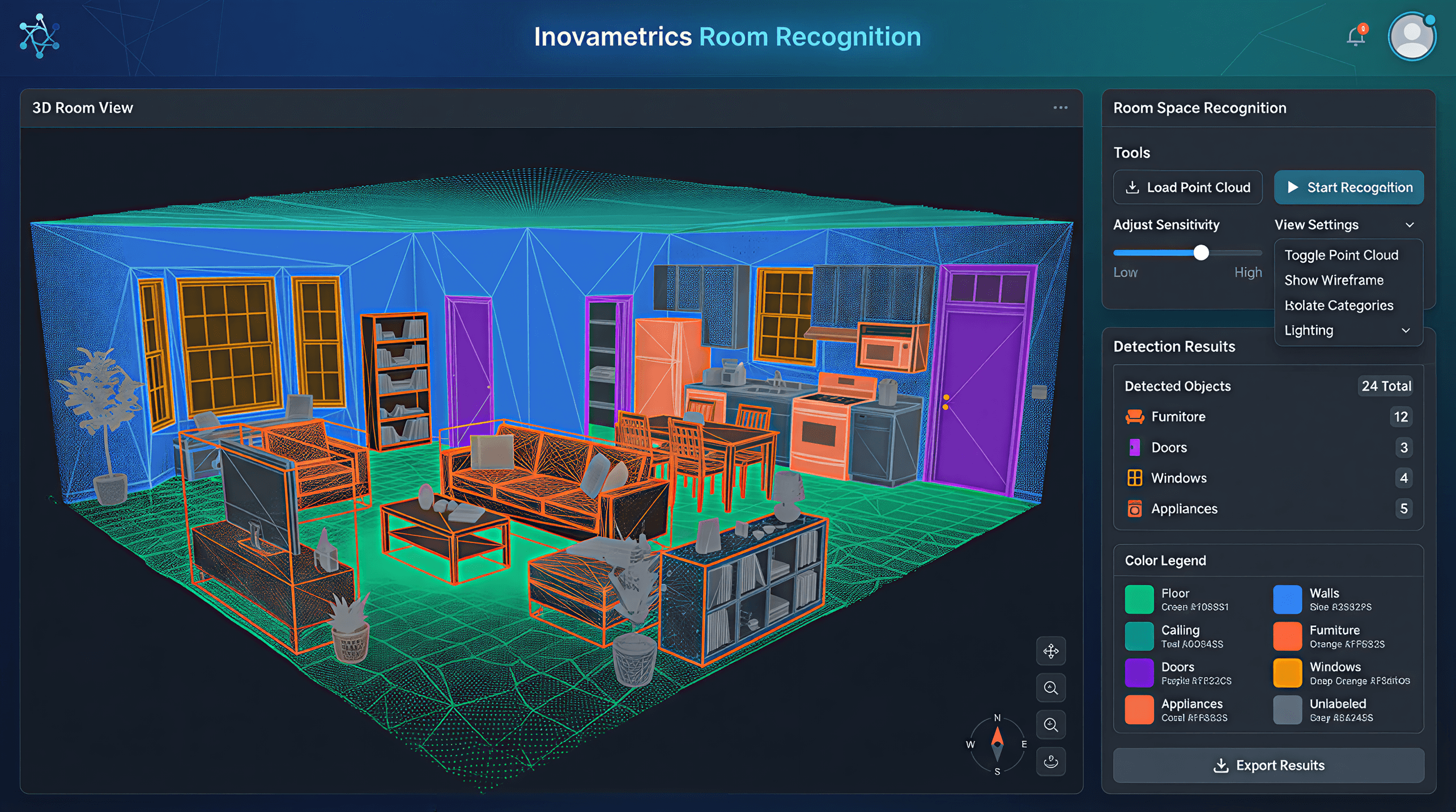
LiDAR scanning produces density.
Millions of points sampled across surfaces, edges, and volumes.
On its own, this density can be visually impressive.
But density is not structure.
A raw point cloud is a record of spatial presence. It describes where surfaces exist in space, but it does not explain what those surfaces represent. A cluster of points may outline a wall — or a temporary object. A vertical plane may be structural — or incidental.
For design and production workflows, the distinction matters.
Data Is Not Yet Geometry
A point cloud is continuous, but it is unclassified.
Points have position.
They do not have meaning.
To draft, fabricate, or install, professionals need geometric relationships:
A wall plane with defined orientation
An opening with clear boundaries
Intersections that resolve into corners
Surfaces that can be dimensioned consistently
Without this translation, a point cloud remains observational data.
Usable geometry requires interpretation.
The Cost of Raw Density
High-density scans reduce omission.
They do not automatically reduce ambiguity.
If drafting relies directly on raw point clouds:
Edges must be traced manually
Planes must be inferred
Openings must be identified
Irregularities must be interpreted visually
The dataset is complete, but the geometry is still reconstructed by hand.
In that sense, density alone shifts the source of measurement — but not the structure of work.
Structured Geometry as Extraction
Structured geometry does something different.
Instead of asking the designer to interpret the cloud, the system identifies relationships algorithmically:
Wall planes are detected based on spatial clustering
Openings are segmented from surrounding surfaces
Angular deviations are preserved rather than corrected
Dimension layers are generated from plane intersections
The result is not just a visual model.
It is a geometric framework.
A framework reduces the number of assumptions required downstream.
Why Structure Matters More Than Points
Design decisions rely on relationships, not samples.
Cabinet alignment depends on plane consistency.
Panel fabrication depends on accurate corner resolution.
Installation tolerances depend on understanding true verticality and deviation.
Raw points describe reality.
Structured geometry explains it.
When geometry is structured:
Walls behave as planes, not point clusters
Corners resolve as intersections, not approximations
Deviations are quantified, not visually estimated
The workflow becomes referential instead of reconstructive.
From Observation to Usability
There is a subtle but important shift between recording space and operationalizing it.
Recording captures what exists.
Structure defines how it can be used.
A dense point cloud may reduce the risk of missing data.
Structured geometry reduces the effort required to act on it.
For designers and contractors, this distinction determines whether scanning is a visual aid or a production foundation.
A Change in Starting Conditions
Moving from raw scan to structured geometry does not replace drafting expertise.
It changes the starting condition of the work.
Instead of rebuilding geometry from visual interpretation, professionals begin with extracted planes, resolved intersections, and dimension-ready relationships.
The underlying space has not changed.
What changes is how directly that space can enter design and fabrication workflows.
And in complex projects, reducing interpretive steps often matters more than increasing data density.