Site Survey
Site Survey
Reframing Measurement in Interior Design
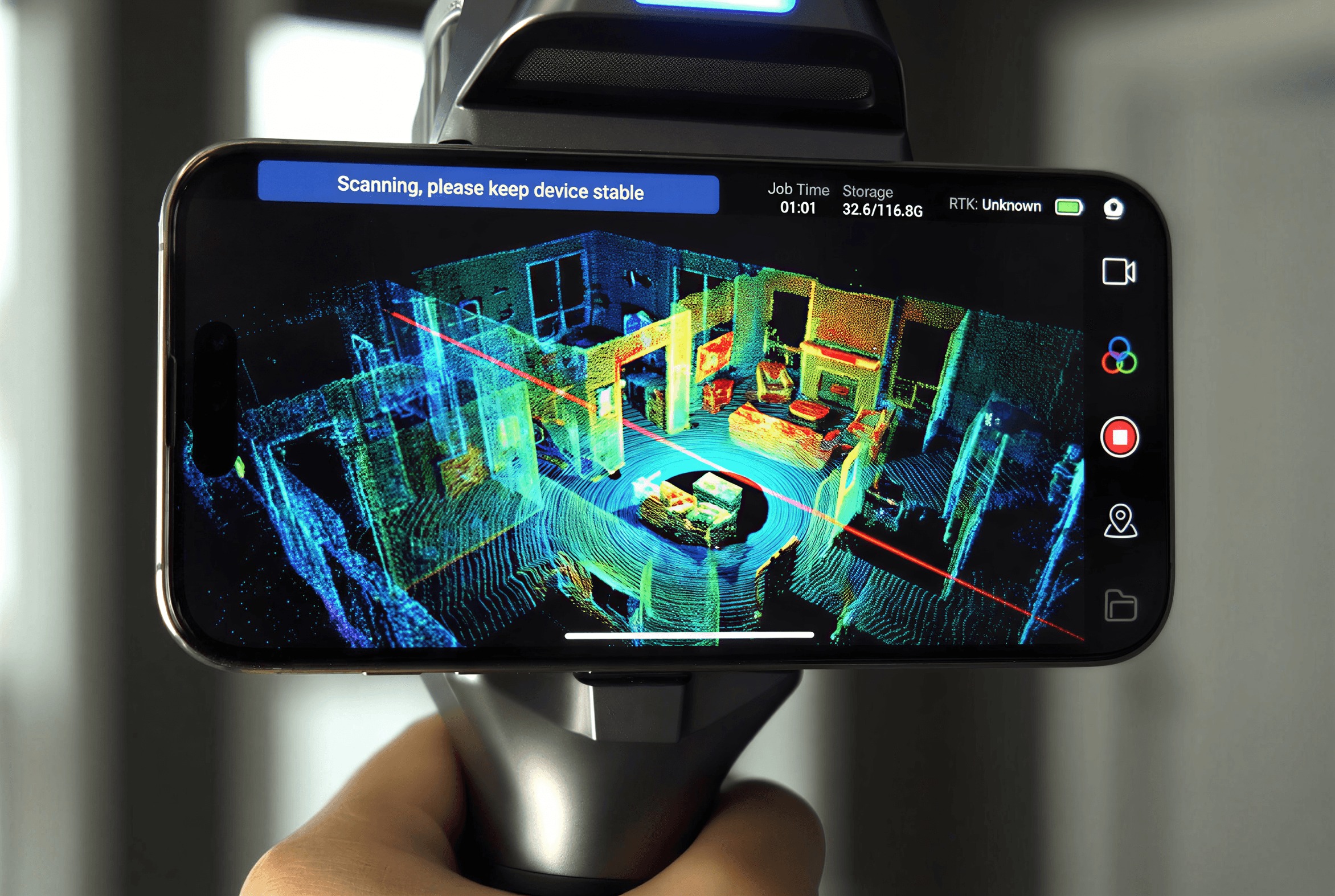
Point cloud capture is reshaping how spaces are measured and interpreted, moving beyond selective dimensions to full spatial context. In this article, we explore how LiDAR supports traditional measurement workflows and improves accuracy across design and construction projects.
When Measurement Becomes Continuous
In most projects, measurement is a focused act.
A professional walks into a space with intention.
Certain walls are checked.
Openings are noted.
Heights are confirmed.
The work is careful and deliberate.
But it is also selective.
No matter how experienced the surveyor is, manual measurement captures what is necessary — not everything that exists.
And in most cases, that is sufficient.
The Nature of Manual Measurement
Traditional site surveys are built on precision and judgment.
A wall is measured because it defines layout.
A ceiling height is captured because cabinetry depends on it.
An opening is confirmed because it affects clearance.
This workflow works well when geometry behaves predictably.
But built environments are rarely perfect.
Walls are not always fully vertical.
Corners are not always exact.
Surfaces may deviate slightly from what drawings assume.
In manual workflows, small deviations are either corrected during drafting or adjusted during installation.
The system absorbs the imperfection.
What Point Cloud Capture Adds
LiDAR-based capture does not replace professional judgment.
It extends what can be recorded.
Instead of sampling dimensions, it captures spatial continuity.
A point cloud model stores:
Surface positions
Angles
Depth relationships
Subtle deviations across planes
It records the physical structure as it exists — not as it is interpreted.
This doesn’t eliminate the need for expertise.
It changes the starting point.
From Selected Dimensions to Full Context
In manual measurement, the surveyor decides which dimensions matter.
With point cloud capture, the entire space becomes referenceable.
If a corner is slightly off square, the data preserves that.
If a wall leans by a small margin, that relationship remains embedded in the dataset.
When drafting later occurs, it is not reconstructing geometry from isolated numbers.
It is interpreting a spatial record.
The distinction is subtle but important.
One approach builds geometry from selected measurements.
The other derives geometry from a captured structure.
Why This Is Relevant to Design Work
For designers and contractors, measurement is not an end.
It is a foundation.
Cabinet alignment, panel fitting, installation tolerances — these depend on how accurately space is understood at the beginning.
Point cloud models reduce reliance on assumption.
They do not guarantee perfection.
But they reduce the likelihood that minor geometric inconsistencies will surface late in the process.
Instead of discovering a deviation during installation,
it can be observed earlier — in model space.
A Complement, Not a Replacement
Manual measurement will continue to play a role in site work.
There are moments where confirmation and professional judgment are essential.
What LiDAR adds is continuity.
Instead of isolated checkpoints in space,
the environment becomes a continuous dataset.
That continuity supports drafting, coordination, and production workflows — particularly when projects involve tight tolerances.
It is not about redefining the profession.
It is about broadening what can be reliably recorded.
A Different Starting Point
The shift is quiet.
From measuring parts of a room
to preserving the room itself.
From selecting dimensions
to retaining spatial relationships.
When point cloud data supports measurement workflows,
design begins with a fuller spatial context.
Not louder.
Not revolutionary.
Just more complete.