Site Survey
Site Survey
What Really Happens During a Site Survey
A traditional site survey reduces complex physical space into a manageable set of selected dimensions. This article examines how manual measurement relies on inference and assumption — and how point cloud capture provides a more continuous spatial foundation for drafting and production workflows.
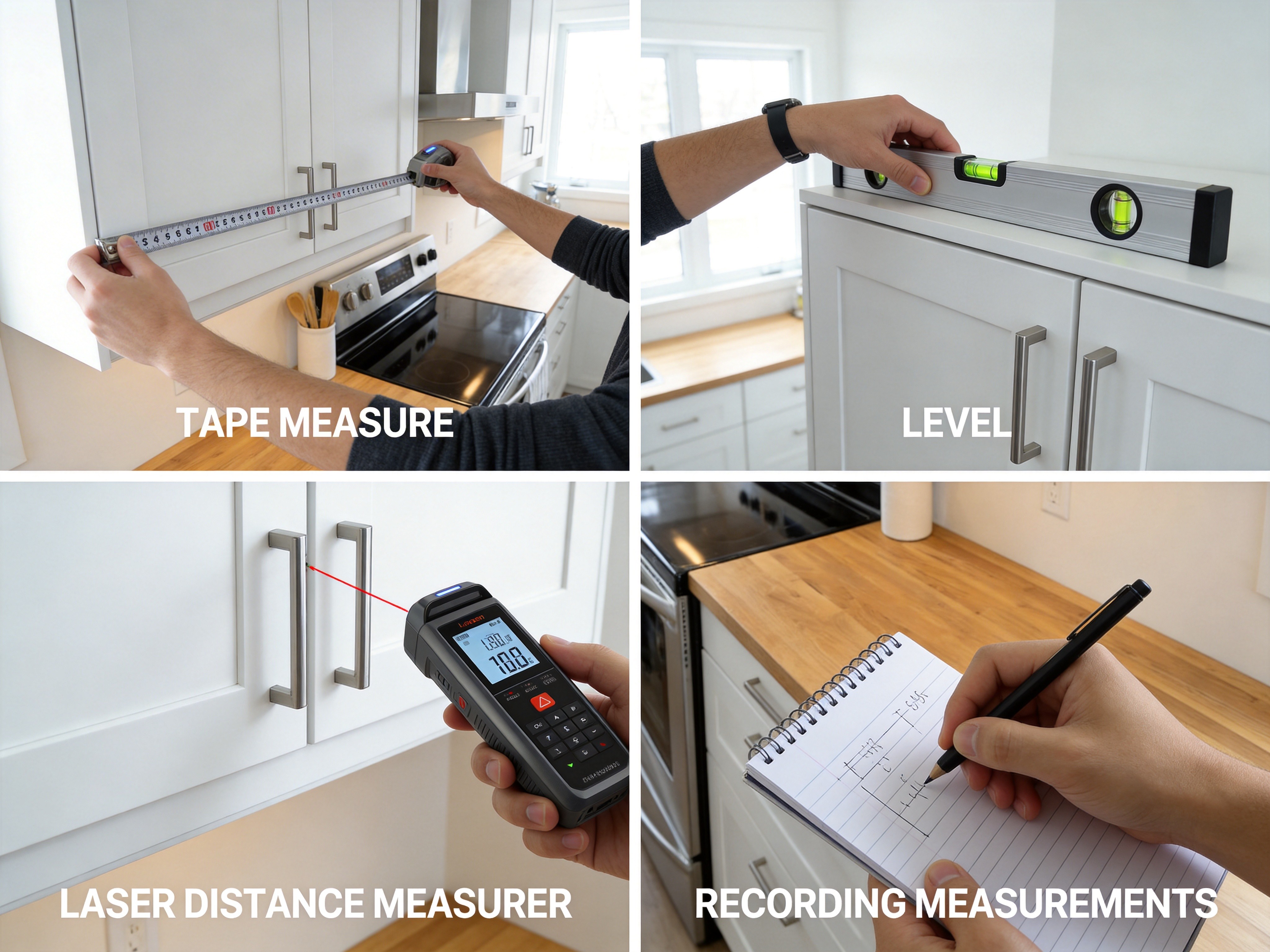
A site survey reduces a complex physical environment into a limited set of measurements.
That reduction is necessary.
A built space contains more information than any professional can fully capture by hand — surface irregularities, minor angular deviations, layered materials, structural tolerances accumulated over time. Manual measurement does not attempt to record all of it. It extracts what appears essential.
The process is selective by design.
Surveyors identify reference walls, key spans, ceiling heights, opening widths. They confirm what will directly influence layout, fabrication, and installation. Everything else is treated as background — assumed to behave within acceptable tolerance.
This is not a flaw in the profession.
It is a practical constraint.
Discrete Data, Continuous Geometry
Manual measurement produces discrete values.
Each number may be precise:
10'-4 1/2" across a wall.
8'-0" to ceiling.
36" door opening.
But a drawing requires continuity. Lines must connect. Corners must meet. Planes must align.
Between field notes and finished drawings lies reconstruction.
Geometry is rebuilt from selected points.
Angles are inferred.
Verticality is assumed unless proven otherwise.
Most of the time, the reconstruction holds.
Occasionally, it doesn’t.
Small deviations — a wall leaning slightly, a corner opening by a fraction of a degree — may not register during measurement. They surface later, when cabinetry aligns imperfectly or panels require adjustment.
The survey was accurate.
The geometry was incomplete.
Environmental Variables
Site conditions are rarely neutral.
Furniture may still be in place.
Access may be limited.
Construction may be ongoing.
Lighting may distort visual cues.
Professionals adapt. They measure around obstacles, estimate inaccessible spans, and rely on experience to close gaps.
Again, this is not error.
It is compression under constraint.
The survey must finish within hours, not days. The dataset must remain manageable.
The Role of Assumption
The industry operates on a workable premise: built environments are generally stable within a reasonable tolerance range.
Walls are close to vertical.
Floors are close to level.
Corners are close to square.
Without these assumptions, drafting would become unmanageable. Every surface would require exhaustive verification.
Assumption is efficiency.
But assumption is also risk — not dramatic risk, but cumulative friction.
Each inferred relationship introduces the possibility of minor correction downstream.
A revisit.
A field adjustment.
A tolerance shift during installation.
Where Point Cloud Capture Enters
Point cloud capture changes the structure of the dataset.
Instead of extracting selected dimensions, it records spatial continuity.
Every surface is sampled.
Every deviation is preserved.
Angular inconsistencies are not corrected by assumption — they are retained in the model.
The difference is not density alone.
It is completeness.
Manual surveys build geometry from fragments.
Point cloud models derive geometry from a full spatial record.
This does not eliminate professional judgment.
It reduces the number of assumptions required.
Measurement as Foundation
A site survey defines the foundation of the project.
If that foundation is selective, downstream workflows rely on interpretation.
If that foundation is continuous, drafting becomes less reconstructive and more referential.
The craft of design does not change.
Installation skill does not change.
Tolerance still matters.
What changes is the starting condition.
Instead of compressing space into fragments and rebuilding it later, the entire physical structure is preserved as context.
In complex projects, that difference is not loud.
It is structural.
And structural differences compound.